Malting Overview
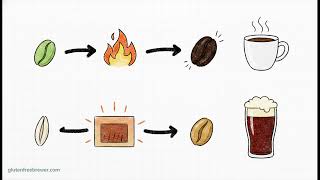
Never worked with malt before? Here is the whole idea in one breath: malt is sprouted grain, finished with heat for flavor — the way coffee starts as a green bean and only becomes coffee in the roaster. Sprouting wakes the grain up and changes what is inside it. The heat — drying and kilning always, roasting when you want it darker — decides what it tastes like. Everything else on this page is control around those two moves.
Malt gives beer its grain flavor, aroma, color, body, depth, structure, and identity. Fermentable sugar can make alcohol. Malt is what makes a grain-based drink taste and feel like beer.
Malting awakens grain, changes it through germination, then stabilizes and shapes it through drying, kilning, or roasting. The point is not to create a gluten-free imitation of barley malt. The point is to make useful malt for better gluten-free beer.
 Watch on YouTubeWhat Is Malt? The Journey from Grain to CharacterThis page as a video — steeping, germination, kilning, end to end.
Short on time? Malt Is a Verb covers the core idea in three minutes. Both were AI-generated from this page and reviewed for accuracy.
The three shaded stages are the malting transformation; acceptance gates the lot in, finished-malt QA gates it out. GFB malts for character — conversion is designed separately with external enzymes.
The Governing Division of Labor
Malt character and mash conversion are related, but they are not the same job.
Malt for character. Design conversion with external enzymes.
Native malt enzymes are a distraction. Ignore them. External enzymes own conversion.
Native enzyme activity may be measurable, but Gluten Free Brewer does not credit it as conversion capacity or design around it. The maltster should not sacrifice flavor, color, stability, roast potential, or drinkability to preserve native enzyme activity.
| Job | Owner |
|---|---|
| Grain flavor, aroma, color, body, toast, roast, structure, and beer identity | Malt and malt design |
| Conversion power | External enzymes |
| Starch access, gelatinization, pH, temperature, time, water, and mixing | Mash process |
| Final proof | Wort, fermentation, and finished beer |
Raw Grain Is Not Malt
Raw grain can supply starch, body, flavor, or targeted recipe support. It has not been through the controlled germination and heat work that creates malt character and stable brewing material.
Don't expect raw grain to carry the job of malt.
If raw grain enters the recipe, the mash still has to make its starch accessible and the external-enzyme system still has to convert it.
Syrup Is Not Malt
Syrup can add gravity, consistency, convenience, and production speed. It is not automatically bad.
It also does not automatically supply malt aroma, toast, roast, body structure, grain depth, or beer identity. A syrup-heavy wort can ferment correctly and still produce a beer that feels assembled rather than brewed from grain.
The full job map — malted grain, syrup, adjuncts, and external enzymes, each with what it does and does not replace — lives on Malted Grain vs Syrup vs Adjunct.
What Malting Adds
Malting adds value in layers:
- grain identity instead of neutral fermentable alcohol;
- aroma and flavor that survive into finished beer;
- toast, roast, color, and depth through deliberate heat treatment;
- body and structure that help the beer feel complete;
- process-relevant change in hydration, milling, and wort contribution;
- repeatable quality through lot records, retained samples, malt QA, and brewing trials.
Gravity matters. Gravity is not the whole beer.
Why Sorghum Malting Matters
Sorghum is central to serious gluten-free brewing because it can become useful brewing malt at commercial scale. It gives brewers a path beyond syrup-only formulation and raw-starch workarounds — a real malted-grain foundation instead of assembled gravity.
Sorghum malt should make better beer, not pretend to be barley. Its job is to build a gluten-free malt foundation: grain flavor, aroma, color, body, roast potential, depth, stability, and beer identity. It should give the brewer a material worth learning, recording, and improving.
Its job is not to carry conversion. External enzymes own conversion from the start.
The grain still has to earn its way in. Bad grain cannot be fixed by clever malting: the lot needs identity, viability, soundness, gluten-free suitability, and a known storage history before the steep ever starts. Malting develops potential — it does not repair anonymous, damaged, stale, or mold-risk grain.
External Enzymes Own Conversion
The mash system must still be designed. External enzymes cannot fix starch they cannot reach or conditions that fight their activity.
A real conversion system includes:
- milling and hydration that expose the material;
- gelatinization and liquefaction;
- external enzyme selection and sequence;
- product-specific pH and temperature control;
- time, water, and mixing;
- wort separation and recovery;
- batch records and finished-beer proof.
This division keeps the work honest. The maltster builds malt for beer character. The brewer builds a mash system that converts reliably.
Flavor-First Still Needs QA
Flavor-first does not mean casual. Bad grain does not make good malt.
Sorghum intended for malting still needs:
- known source and lot identity;
- gluten-free handling;
- acceptable storage history;
- germination confidence;
- cleaning and sorting;
- appropriate mold and mycotoxin controls;
- retained samples;
- finished-malt release;
- controlled brewing trials.
Quality control protects flavor and trust.
The Finished Beer Gets the Last Word
The useful proof chain is:
- the grain passed acceptance;
- the malt stayed controlled and traceable;
- finished-malt QA released it to a controlled brewing trial;
- the external-enzyme mash produced useful wort;
- fermentation behaved;
- the finished beer gained flavor, aroma, body, color, balance, or drinkability;
- the result repeated.
The beer does not replace safety release. It proves performance after safety release.
Practical Takeaways
- Malt is the soul of beer, and the heart of gluten-free brewing.
- Malt for flavor, aroma, color, body, depth, stability, and beer identity.
- Ignore native malt enzymes in conversion design.
- Never weaken malt character to preserve native enzyme activity.
- Design conversion with external enzymes.
- Build the mash around starch access and the conditions those external enzymes require.
- Judge the malt by the beer it helps make.