Rice Overview
Rice is useful in gluten-free brewing because it gets out of the way.
Often that is exactly the job. Rice lightens stronger grains, adds clean extract, and keeps a pale or delicate beer from turning heavy — and its quietness makes everything else in the glass easier to read.
Quiet is also the warning label. The beer still needs flavor structure, body, foam support, yeast nutrition, and a process that will actually run on brew day. Rice helps with parts of that. Don't ask it to carry all of it.
In my view, rice belongs in the support column first.
Rice Quick View
| Field | Practical read |
|---|---|
| Common name | Rice |
| Scientific name | Usually Oryza sativa in global rice production |
| Crop type | Cereal grain |
| Brewing forms | Raw rice, broken rice, flaked rice, pregelatinized rice, rice syrup or extract, malted rice, roasted or specialty rice, and rice hulls |
| Gluten-free status | Naturally gluten-free as a grain; ingredient suitability still depends on sourcing and process control |
| Primary brewing strength | Clean fermentable support, lightness, and quietness |
| Primary brewing weakness | Weak complete malt-system contribution by itself |
| Key process question | Is the starch accessible to the process being used? |
| Best practical fit | Support grain, adjunct, extract source, or specialty contribution, not automatic foundation |
Name the form first, then name the job. That is the whole rice decision in one line.
Why Rice Matters, But Not Too Much
Rice is one of the world's major staple grains, milled and traded at enormous scale, which for brewing means one narrow and useful thing: it is familiar, available, and sold in forms you can actually buy.
Availability is not the same as foundation.
In conventional brewing rice is an adjunct — it lightens color, softens malt intensity, and adds fermentable material without much flavor of its own. That adjunct logic carries into gluten-free brewing far better than any comparison to barley malt does.
The Kernel Explains the Brewing Behavior
"Rice" is too vague to buy on. The hull, bran layers, germ, and endosperm each raise a different brewing question.
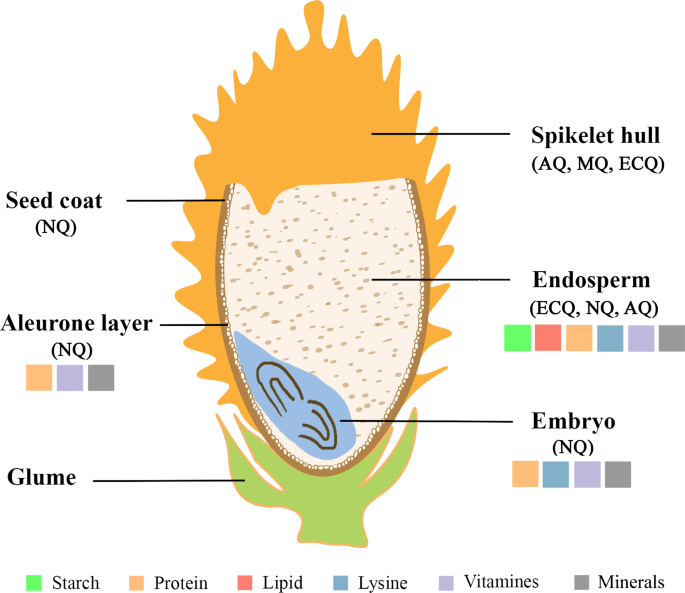
Rice Kernel Structure and Brewing Relevance
| Kernel part or milling state | What it means for brewing |
|---|---|
| Hull or husk | A protective outer layer. When separated as rice hulls, it is a mechanical lautering aid, not fermentable rice grist. |
| Bran and outer layers | More flavor, nutrient, lipid, storage, and process implications than polished endosperm. Do not assume brown or less-refined rice behaves like polished white rice. |
| Germ or embryo | Relevant to grain biology, nutrient behavior, flavor, and storage. Usually reduced or removed in polished white rice products. |
| Starchy endosperm | The main starch reserve. This is why polished rice is useful as clean extract support. |
| Polished white rice | Mostly starch-forward endosperm. Clean and quiet, but weak as complete beer structure. |
Brown, polished, milled, and hull products are not one ingredient. Buy them as if they were and the mash will tell you the difference.
Rice In Gluten-Free Brewing
Rice helps when the beer needs:
- clean fermentable support
- less color
- less grain intensity
- lighter finish
- a quieter base for hops, yeast, fruit, spice, or another grain
- specialty color or flavor when the rice product earns that role
Rice gets risky when the beer needs:
- most of its malt character from rice
- body and foam support from rice alone
- yeast nutrition without a broader nutrient plan
- raw starch to convert without a starch-access plan
- pale rice malt to behave like barley malt
External enzymes are normal tools in gluten-free brewing - they help solve conversion problems, not beer-structure problems. See Rice Processing in Gluten-Free Brewing for how enzymes actually fit the mash.
Rice Form Quick Map
| Rice form | Overview role | Where the detail belongs |
|---|---|---|
| Raw or broken rice | Clean starch source with a process burden | Rice Processing in Gluten-Free Brewing |
| Flaked rice | More process-ready adjunct, source-dependent | Rice Processing in Gluten-Free Brewing |
| Pregelatinized rice | Easier starch-access adjunct, product-specific | Rice Processing in Gluten-Free Brewing |
| Rice syrup or extract | Already-converted fermentable support | Malted Grain vs Syrup vs Adjunct |
| Malted rice | Real rice malt category, but cultivar-, source-, and process-dependent | Rice as Adjunct vs Base Malt and Malting Overview |
| Roasted or specialty rice | Flavor, color, aroma, or specialty expression | Product-specific evidence and sensory trials |
| Rice hulls | Mechanical lautering aid | Rice Processing |
Processing Belongs on the Processing Page
Whether rice can convert is the easy question. The useful ones are whether the starch is accessible, whether the form arrives raw or already processed, how the mash will move once it is in there, and what the beer still needs after conversion is done.
That work lives on Rice Processing in Gluten-Free Brewing.
Brewing Properties Quick View
| Brewing property | Practical read |
|---|---|
| Fermentable contribution | Useful when starch access and conversion are handled, or when using syrup or extract. |
| Flavor | Usually quiet in pale forms; product-dependent in malted, roasted, aromatic, or pigmented forms. |
| Color | Generally pale in polished or light forms; specialty products can change the role. |
| Body and mouthfeel | Not rice's strongest contribution by itself. Needs support from the rest of the system. |
| Foam support | Do not assume rice solves foam. Treat this as source- and formulation-dependent. |
| Yeast nutrition / FAN | Variable by form, cultivar, and malt process. Do not assume enough without data. |
| Native enzyme contribution | Research context, not the main Gluten Free Brewer process baseline. |
| Lautering/process structure | Huskless rice grist can create process problems; rice hulls are a separate mechanical aid. |
| Best fit | Clean adjunct support, lightness, process-specific starch or extract use, and specialty rice expression. |
This is qualitative guidance. It should not be read as measured data or as permission to skip supplier specs.
Where Rice Helps And Where It Breaks
| Rice helps when... | Rice breaks down when... | Practical consequence |
|---|---|---|
| The beer needs clean gravity without much flavor | The recipe needs rice to provide most of the malt character | Rice can lighten a beer, but it will not build a malt backbone by itself. |
| A stronger gluten-free grain needs softening | The rest of the grain bill is already thin | Rice can make a beer cleaner or emptier, depending on what else is carrying structure. |
| A crisp, pale, dry, or delicate beer is the target | The style needs rich malt depth, foam, or body | Use rice for quietness, not for every structural role. |
| The rice form is process-ready or the process is designed for it | Raw or form-dependent rice is used without starch-access control | Conversion depends on accessible substrate, not wishful thinking. |
| Roasted or specialty rice brings a clear flavor or color job | Specialty rice is judged only by extract | Ask what it contributes after conversion, not just whether it adds starch. |
| Rice hulls are used for bed structure | Hulls are counted as rice extract or flavor | Hulls help separation. They are not fermentable grist. |
The risk is not that rice is useless. The risk is asking a quiet support grain to do everyone else's job.
Gluten Free Brewer Interpretation
In my view, rice belongs in the support column first.
I would use rice to clean up, lighten, quiet, or sharpen a beer before I would trust it as the foundation. That is a practical formulation warning, not a law of physics. Selected rice malts can work under controlled conditions. All-rice beers can be made. Rice malt research is real.
It still does not make rice barley.
The safer working model is simple: use rice when its quietness solves a recipe problem. Be careful when quietness becomes the plan.
Where To Go Next
| If you are trying to decide... | Read this next | Why |
|---|---|---|
| Whether rice should support the beer or carry it | Rice as Adjunct vs Base Malt | That page owns the practical support-versus-foundation decision. |
| How the chosen rice form behaves in the brewhouse | Rice Processing in Gluten-Free Brewing | That page owns starch access, gelatinization, enzyme workflow implications, mash handling, runoff, and process failure modes. |
| Why extract is not the same as malt function | Malting Overview | Malt contributes more than fermentable material. |
| Whether syrup, adjunct, and malted grain are the same decision | Malted Grain vs Syrup vs Adjunct | Those ingredient categories solve different problems. |
| How enzymes fit gluten-free conversion | Gelatinization Temperature | Enzyme strategy belongs on the process page, not in a grain overview. |
| Whether rice hulls count as rice in the grist | Rice Processing | Hulls are a mechanical process aid, not fermentable rice contribution. |
This is the Rice section map. If a question needs a mash schedule, a gelatinization discussion, an enzyme program, or a failure-mode table, it belongs on a deeper page.
What This Overview Does Not Try To Settle
This page does not give rice usage ranges, gelatinization values, enzyme schedules, free amino nitrogen (FAN) targets, protein targets, extract values, diastatic power values, rice hull rates, or recipe formulas.
Those numbers can matter, but they need source-specific context, supplier specifications, field validation, or cleaned datasets before they belong in public guidance. A parent overview should explain the grain and route the decision. It should not pretend one number covers raw rice, flaked rice, pregelatinized rice, syrup, malted rice, roasted rice, hulls, and every beer style.
Practical Takeaway
Rice is useful because it is clean and quiet. It is limited for the same reason.
Name the rice form. Name the job. Then decide whether rice is supplying clean support, finished-beer structure, specialty character, or a process problem that has to be controlled.
References and Technical Basis
- Rice as Adjunct vs Base Malt - owns the practical decision between rice as clean adjunct and rice as risky base-malt foundation.
- Rice Processing in Gluten-Free Brewing - owns starch access, gelatinization, enzyme workflow implications, mash handling, runoff, and rice processing failure modes.
- Malting Overview - supports the distinction between fermentable extract and fuller malt function.
- Malted Grain vs Syrup vs Adjunct - supports the distinction between grain, syrup or extract, and adjunct roles.
- Gelatinization - owns broader starch-access, gelatinization, and enzyme-strategy theory.
- Rice Processing in Gluten-Free Brewing - keeps rice hulls in their proper lane as a mechanical process aid.
- USDA Economic Research Service, Rice - Rice Sector at a Glance. Used for public rice crop, species, staple, trade, and brewing-use context.
- FAO, Agricultural production statistics 2010-2024. Used for current cereal production context.
- Li, P., Chen, Y.-H., Lu, J., Zhang, C.-Q., Liu, Q.-Q., and Li, Q.-F. 2022. Genes and Their Molecular Functions Determining Seed Structure, Components, and Quality of Rice. Rice 15, 18. Used for rice seed structure and Figure 2 image attribution, CC BY 4.0.
- FAO, Rice in human nutrition. Used for rice grain structure, milling, and composition background.
- IRRI Rice Knowledge Bank, Milling and Rice by-products. Used for hull, bran, endosperm, and milling/by-product distinctions.
- Briess, Brewing with Flakes. Used for flaked adjunct context and the process-readiness distinction.
- Guimaraes et al. 2024. Investigating the Malting Suitability and Brewing Quality of Different Rice Cultivars. Beverages 10(1):16. Used as rice malt research context, especially cultivar-dependent malting and brewing traits.
- Guimaraes, B. P., Rani, H., and Lafontaine, S. 2026. Identifying and overcoming challenges in scaling up malted rice for commercial malting and brewing. BrewingScience 79(3/4), 30-52. Used for rice malt scale-up, process-sensitivity, exogenous-enzyme, and specialty rice context.
- Mayer et al. 2016. Development of an all rice malt beer: A gluten free alternative. LWT - Food Science and Technology 67, 67-73. Used as research feasibility context, not automatic production guidance.