Corn Overview
Corn is useful in gluten-free brewing because it can stay out of the way.
That can be exactly the job. Corn can add gravity, lighten a beer, soften stronger gluten-free grains, and make a crisp beer easier to drink.
Quiet is also the warning label. If the rest of the beer is thin, corn will usually make that problem more obvious. Starch is not the whole beer.
Corn Quick View
| Field | Practical read |
|---|---|
| Common name | Corn; maize in many technical and international sources |
| Scientific name | Zea mays |
| Crop type | Cereal grain |
| Brewing forms | Flaked corn, torrefied maize, grits, meal, flour, corn syrup solids, degermed products, malted corn, and roasted or specialty corn products |
| Gluten-free status | Naturally gluten-free as a grain; ingredient suitability still depends on sourcing and facility control |
| Primary brewing strength | Clean fermentable support, lightness, availability, and form flexibility |
| Primary brewing weakness | Weak complete beer structure by itself, especially in pale adjunct forms |
| Key process question | Is the starch accessible to the process being used? |
| Best practical fit | Adjunct support, extract source, lightness tool, or specialty contribution, not automatic foundation |
This table is an overview map, not a specification sheet. The first useful corn decision is to name the form, then name the job.
Why Corn Matters, But Not Too Much
Corn matters because it is enormous in agriculture, familiar in brewing adjunct use, and available in many processed forms. For brewers, the important point is narrower: corn is easy to find and easy to misunderstand.
That does not make corn a complete brewing foundation.
In conventional brewing, corn usually works as an adjunct. It can lighten body, soften malt intensity, and add fermentable material without much flavor. That adjunct logic transfers into gluten-free brewing better than a base-malt comparison does.
The Kernel Explains The Brewing Behavior
Corn is not just "starch." The starchy endosperm, germ, outer layers, and tip cap point to different brewing questions.
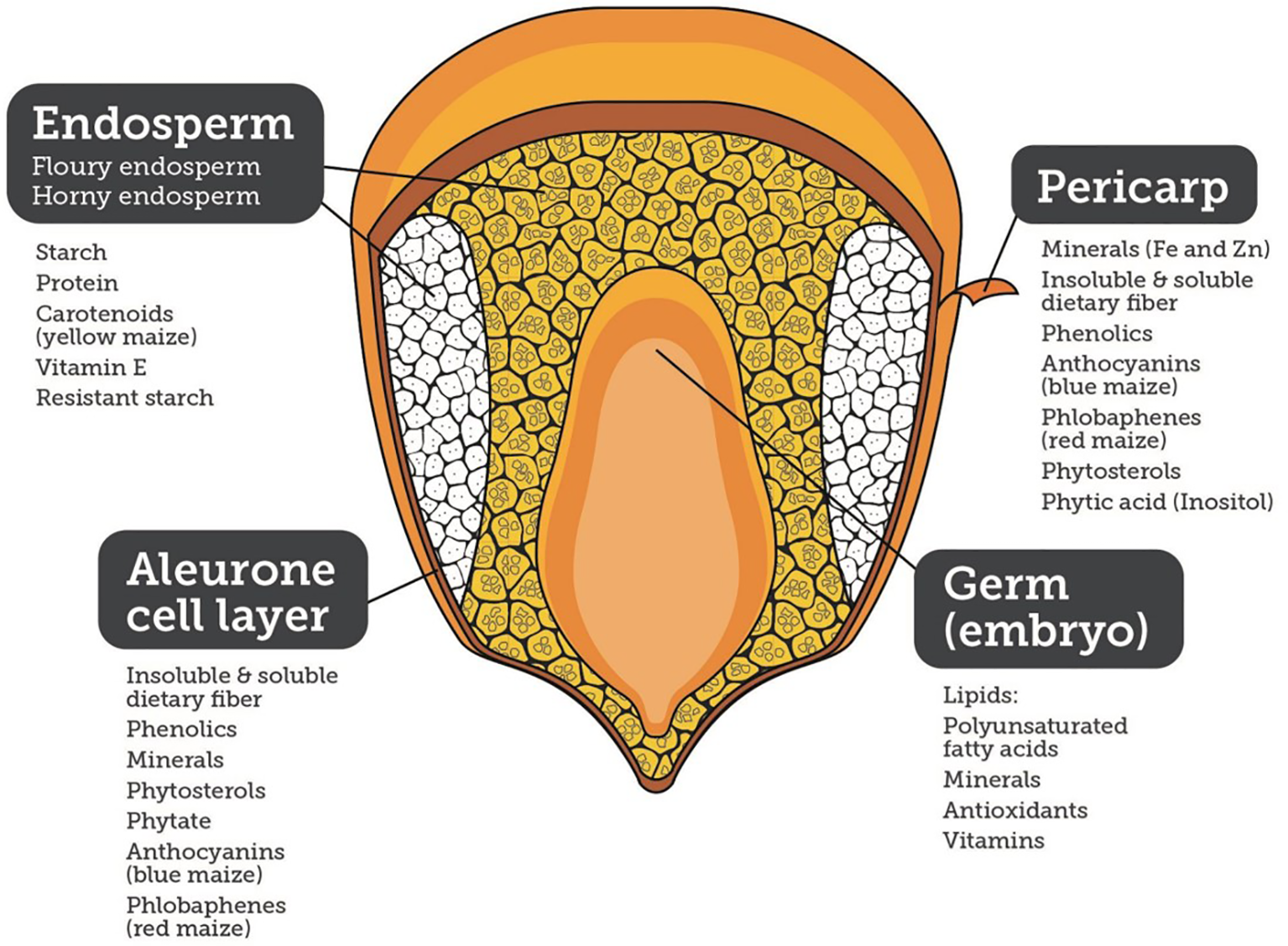
Corn Kernel Structure and Brewing Relevance
| Kernel part or processing state | What it means for brewing |
|---|---|
| Starchy endosperm | Main extract target. Endosperm-heavy products are why corn can work as clean fermentable support. |
| Germ or embryo | Oil-rich and biologically active. In malted corn, germ and oil character can become a sensory problem. |
| Pericarp and outer layers | Affect milling, fines, fiber, and process behavior. Whole-kernel products are not the same as refined adjunct products. |
| Tip cap | Attachment point at the cob end of the kernel. It is a small fraction, but it reinforces the bigger point: a whole kernel brings more than endosperm starch. |
| Degermed corn products | Adjunct products with much of the germ and bran removed. Useful for clean adjunct logic, but not equivalent to malted corn. |
| Whole-kernel malted corn | Can carry more full-grain character. That may include malt character, and it may also carry oil, waxy, or mouthcoating character. |
This is brewing orientation, not a milling manual. The point is that "corn" is too vague by itself.
Corn In Gluten-Free Brewing
Corn helps when the beer needs:
- clean fermentable support
- lighter body or finish
- less grain intensity
- a softer base under sorghum, millet, buckwheat, hops, yeast, fruit, or spice
- simple gravity from syrup solids
- specialty color or flavor when the corn product earns that role
Corn gets risky when the beer needs:
- most of its malt character from corn
- body and foam support from corn alone
- yeast nutrition without a broader nutrient plan
- raw starch to convert without a starch-access plan
- malted corn to behave like a proven gluten-free base malt
External enzymes are normal tools in gluten-free brewing. They help conversion. They do not turn corn extract into finished beer structure.
Corn Form Quick Map
| Corn form | Overview role | Practical warning |
|---|---|---|
| Flaked corn or torrefied maize | Process-ready adjunct for clean extract and lightness | Still an adjunct. It does not bring full malt structure. |
| Corn grits | Adjunct starch source when the process is built for it | Raw or under-processed grits need a starch-access plan. |
| Corn meal or corn flour | Fine adjunct material with more surface area | Fine particles can thicken, clump, compact, or load the mash with solids. |
| Corn syrup solids | Fermentable contribution without whole-grain starch handling | Syrup solids supply extract. They do not supply malt structure. |
| Degermed corn products | Cleaner adjunct products with reduced germ and oil fraction | Degermed adjunct logic does not automatically solve malted corn. |
| Malted corn | Potential malt character, color, aroma, and grain expression | Needs sensory proof. Malted Corn in Gluten-Free Brewing owns the deeper warning. |
| Roasted or specialty corn products | Flavor, color, toast, roast, or regional ingredient expression | Judge the product by what it contributes to the beer, not just by extract. |
This table is a routing map. It keeps the overview from pretending all corn forms behave the same way.
Processing Belongs In The Form Decision
The processing question is not just whether corn can convert. The useful question is whether the starch is accessible, whether the form is raw or already processed, how the mash will move, and what the beer still needs after conversion.
Practical checks:
- Identify the corn form before choosing the process.
- Confirm whether the product is raw, flaked, torrefied, syrup-derived, degermed, malted, or roasted.
- Do not treat corn syrup solids like malted grain.
- Watch fine meal or flour for thickening, clumping, and runoff problems.
- Treat supplier specifications as product-specific.
- Evaluate what the beer has after conversion, not only whether gravity was produced.
Detailed mash schedules, gelatinization values, enzyme programs, and usage rates do not belong in this overview.
Brewing Properties Quick View
| Brewing property | Practical read |
|---|---|
| Fermentable contribution | Useful when starch access and conversion are handled, or when using syrup solids. |
| Flavor | Usually quiet in pale non-malted forms; product-dependent in malted, roasted, or specialty forms. |
| Color | Generally pale in light adjunct forms; specialty products can change the role. |
| Body and mouthfeel | Not corn's strongest contribution by itself. Can make a beer cleaner or thinner depending on the rest of the grist. |
| Foam support | Do not assume corn solves foam. Treat foam as formulation- and process-dependent. |
| Yeast nutrition / FAN | Do not assume enough from corn adjuncts. Build the nutrient plan separately. |
| Native enzyme contribution | Research context, not the main Gluten Free Brewer process baseline. |
| Lipid / oil concern | Most important in malted or whole-kernel contexts. Watch for oily, waxy, coating, or heavy sensory character. |
| Best fit | Clean adjunct support, lightness, simple extract contribution, or specialty corn expression. |
This is qualitative guidance. It is not measured data or permission to skip supplier specs.
Where Corn Helps And Where It Breaks
| Corn helps when... | Corn breaks down when... | Practical consequence |
|---|---|---|
| The beer needs clean gravity or a lighter finish | The recipe needs corn to provide most of the structure | Corn can support a beer. Do not ask it to build the whole beer. |
| A stronger gluten-free grain needs softening | The rest of the grist is already neutral or thin | Corn can smooth a beer or make it emptier. |
| The corn form is process-ready | Raw or fine corn is used without a starch-access and runoff plan | Conversion depends on accessible substrate, not wishful thinking. |
| Corn syrup solids are used for simple fermentable support | Syrup solids are expected to replace malt function | Syrup can help gravity. It does not provide grain complexity or malt structure. |
| Degermed products are chosen for cleaner adjunct behavior | Degermed adjunct logic is applied to whole malted corn | Reducing germ/oil in an adjunct is not the same as proving malted corn. |
| Malted corn is tested as a specialty malt candidate | It is assumed to be a complete gluten-free base malt | Malted corn needs sensory proof, not just conversion proof. |
The risk is not that corn is useless. The risk is using a support ingredient as if it were the whole system.
Gluten Free Brewer Interpretation
In my view, corn belongs in the support column first.
I would use non-malted corn to lighten, clean up, or stretch a beer before I would trust it to carry the beer. That is a practical formulation warning, not a law of physics. Corn can be useful. Corn can also make an already thin beer taste stripped.
Malted corn deserves a harder warning. Some malted corn products sound extremely attractive because they promise malt-forward character from a familiar gluten-free grain. In Gluten Free Brewer field experience, some malted corn has produced heavy, oily, waxy, tooth-coating flavor and mouthfeel that certain brewers find deeply objectionable.
That does not mean every malted corn product is bad. It means malted corn does not get a free pass because it converts or smells promising at first. It has to survive sensory trials in beer.
Where To Go Next
| If you are trying to decide... | Read this next | Why |
|---|---|---|
| Whether malted corn is worth testing | Malted Corn in Gluten-Free Brewing | That page owns malted-corn promise, oily/waxy/coating sensory risk, supplier questions, and practical trial logic. |
| Whether syrup, adjunct, and malted grain are the same decision | Malted Grain vs Syrup vs Adjunct | Those ingredient categories solve different problems. |
| How enzymes fit gluten-free conversion | Gelatinization Temperature | Enzyme strategy belongs on the process page, not in a grain overview. |
| Why starch access matters | Gelatinization Temperature | That page owns broader starch-access and gelatinization theory. |
What This Overview Does Not Try To Settle
This page does not give corn usage ranges, gelatinization values, enzyme schedules, extract values, free amino nitrogen (FAN) targets, protein targets, oil limits, diastatic power values, or recipe formulas.
Those numbers can matter, but they need source-specific context, supplier specifications, field validation, or cleaned datasets before they belong in public guidance. A parent overview should explain the grain and route the decision. It should not pretend one number covers flaked corn, grits, corn meal, corn syrup solids, degermed products, malted corn, roasted corn, and every beer style.
Practical Takeaway
Corn is useful because it can support the beer without taking over. It is limited for the same reason.
Name the corn form. Name the job. Then decide whether corn is supplying clean support, finished-beer structure, specialty character, or a process problem that has to be controlled.
Treat malted corn as promising but unproven until the beer proves otherwise.
References and Technical Basis
- USDA Economic Research Service, Corn and Other Feed Grains. Used for corn agriculture and use context.
- FAO, Agricultural production statistics 2010-2024. Used for global crop context.
- Prasanna et al. 2020, Molecular Breeding for Nutritionally Enriched Maize: Status and Prospects. Used for the maize kernel structure image and kernel-component context. Figure 1, CC BY 4.0.
- Dabija et al. 2021, Maize and Sorghum as Raw Materials for Brewing, a Review. Used for maize brewing, maize malt, and gluten-free brewing research context.
- Cadenas, Caballero, Nimubona, and Blanco 2021, Brewing with Starchy Adjuncts: Its Influence on the Sensory and Nutritional Properties of Beer. Used for corn/maize adjunct forms and brewing-process context.
- Purdue Extension, Feed Ingredient Co-Products of Ethanol Fermentation from Corn. Used for corn kernel structure, endosperm, germ, starch, oil, and milling separation context.
- Purdue Extension, Quality Grain Needs TLC. Used for corn processing and germ/oil context.
- USDA AMS, Corn Meal Commercial Item Description. Used for whole grain, bolted, and degermed corn meal distinctions.
- 21 CFR 137.265, Degerminated white corn meal. Used for the degerminated white corn meal definition and its reduced germ/bran/fat basis.
- RahrBSG/Crisp, Flaked Torrefied Maize. Used as a supplier-specific example of processed maize adjunct positioning.